I. Introduction
China’s new-style tea beverage industry has experienced remarkable growth, driven by changing consumer preferences and growing demand for innovative and experiential tea products. From 2016 to 2025, the market size of China’s new tea industry is projected to witness significant expansion, with revenues increasing from CNY 29.1 billion in 2016 to an estimated CNY 375.0 billion in 2025.

However, despite the promising prospects, players in the new-style tea beverage industry face several challenges and considerations to effectively tap into this lucrative market. Understanding the consumer landscape is essential to devise strategies that cater to their preferences and enhance their experience.
According to a consumer survey conducted by iiMedia, most new-style tea beverage consumers in China are young adults, with those aged between 22 and 40 accounting for a significant proportion. Additionally, female consumers dominate the market, representing 81.7%. Consumption in first and second-tier cities is prevalent, with the eastern region, particularly the East China area, demonstrating a more extensive customer base.
The survey reveals variations in purchasing frequency in consumer behaviour. In 2021, many consumers reported purchasing new-style tea beverages several times daily or daily. However, in 2022, there was a shift in purchase frequency, with fewer consumers making purchases several times a day and more opting for a weekly frequency.
Furthermore, the purchase channels for new-style tea beverages are diverse. In 2021 and 2022, many consumers chose to consume tea beverages at physical stores, while a considerable portion also ordered online for in-store pickup. Third-party food delivery platforms, brand-specific applets, and apps were popular purchase channels.

Consumer preferences and purchasing behaviour can be influenced by various factors, leading to fluctuations in purchase frequency. In 2021, inconveniences caused by the COVID-19 pandemic, high prices, declining preference, lack of innovation, long waiting times, health concerns, fear of weight gain, and limited store availability were the main reasons for reduced purchase frequency. In 2022, factors such as long queues, high prices, limited flavour options, poor service, limited store availability, and other miscellaneous reasons contributed to decreased purchase frequency.

In conclusion, China’s new-style tea beverage industry has witnessed a shift towards online ordering as consumers develop a habit of enjoying these innovative drinks. However, the industry must address the issue of long waiting times to maintain consumer interest and prevent a decrease in order frequency. By embracing digitisation and improving operational efficiency, companies can enhance the overall customer experience and sustain growth in the market.
In the following sections, we will delve into the specific digitisation efforts and achievements of three prominent players in the industry — Nayuki, Heytea and Mi Xue Bing Cheng — to shed light on the transformative potential of digital technologies in this sector.
II. Digitisation Transformation in the New-Style Tea Beverage Industry
Digitisation transformation in the context of the beverage industry refers to incorporating digital technology into all aspects of business operations, fundamentally changing how businesses operate and deliver value to customers. It involves several facets, including establishing digital platforms for transactions and communication, harnessing data-driven insights for better business decision-making, and integrating digital systems for more efficient inventory management.
The adoption of digitisation provides numerous benefits to both businesses and consumers. From the business perspective, it allows for more efficient operations, deeper consumer insights, enhanced customer engagement, and improved decision-making. For consumers, digitisation fosters personalised marketing, faster service times, access to detailed product information, and more streamlined ordering and payment processes.
Despite its potential benefits, the new-style tea beverage industry also needs help adopting digitisation. It encompasses safeguarding data privacy and security, mitigating the burden of substantial upfront setup costs, addressing resistance to change within the corporate culture, and continuously updating and maintaining digital systems to remain pertinent in a persistently evolving tech environment.
Case Studies of China’s New-style Tea Beverage Industry
Within this broader context, we will examine the efforts of three key players in the new-style tea beverage industry, Nayuki, Heytea and Mi Xue Bing Cheng, in embracing digitisation.
Nayuki
Nayuki started its journey in 2014 by establishing its first store in Shenzhen, aiming to create a high-end, freshly made tea experience. From 2017 to 2020, it began global expansion, incorporated a membership system to foster customer loyalty, and diversified its offerings. It successfully launched a fruit-flavoured, sugar-free, sparkling water online. This period also saw Nayuki utilising data collection and analysis to fine-tune its offerings to customer preferences. It led to the discovery of a consumer trend towards healthier, sugar-free tea options.

From 2020 onward, Nayuki shifted its focus towards digital transformation to reduce costs and increase efficiency. One notable achievement was the launch of the Teacore system — a self-developed digital platform facilitating automated scheduling, tea making, and order & shipping processes. Nayuki also implemented automatic tea-making machines across all stores, increasing production capacity and reducing training costs and errors. Emphasising its digitisation commitment, Nayuki continues utilising its digital platform to collect customer preferences and needs, thereby maintaining and upgrading its seasonal menu options. It also prioritises food safety by adopting a “System Supervision + Digital Monitoring” approach, implementing over 20 internal food safety management systems and conducting over 12,000 inspections over two years.

Some actions have substantially boosted Nayuki’s user experience and operational efficiency, demonstrating the potential of digitisation in the beverage industry.
1) Automation
They introduced an “Automatic Bubble Tea Machine” in 2022, which can complete a cup of tea within 10.0 seconds, significantly improving production efficiency by 40.0%.
2) Pricing and Product Design Strategy
The average price per item was reduced from CNY 25.0 to less than CNY 20.0 in 2022. Tailored product line to customer needs, such as introducing healthier options and making the packaging more portable. For instance, the “Nayuki Fruit Tea” using monk fruit juice as a natural sweetener sold nearly 4.0 million bottles in the South China region alone since its launch on September 2022.
3) Virtual Expansion and Customer Engagement
They launched the metaverse platform “Nayuki’s Funland”, including the issuance of virtual currency “Nayuki coins” and virtual stocks, along with NFT surprise boxes. The pre-paid card campaign, which offered CNY 150.0 in value for a CNY 100.0 card, sold out CNY 190.5 million within 72 hours, setting a new sales record in the industry.
4) Data-Driven Inventory Management
They utilised data-driven insights for effective order and inventory control, guaranteeing product availability while avoiding the excess stock. This approach is particularly essential given the limited daily supply of certain items like bread.
Hey tea

On the other hand, Heytea, which operates its tea gardens and intensely cooperates with original tea gardens and upstream tea suppliers, implemented an ERP system to digitise its supply chain as early as 2017. In 2019, it added 15.8 million new users to the Heytea Go applet, showcasing its digital operation capabilities by designing products and strategies tailored to user needs. Its efforts have paid off, with the Heytea Go applet now serving as the core channel for serving its members.
Continuing its digitisation journey, Heytea developed tools in 2022 to predict demand for raw materials and manage new product inventory. It achieved this through dynamically monitoring sales, raw material demand, and information on overall supply chain inventory, improving the operating efficiency of its supply chain and facilitating product research and development. Heytea, through its sustained digitisation efforts, actively demonstrates the effective use of digital tools. This application of technology drives efficiency, elevates the customer experience, and boosts business performance in the new-style tea beverage industry.

One of the most noticeable outcomes of Heytea’s digital transformation is the WeChat applet “Heytea Go”. This app lets customers understand the duration between placing and receiving an order, effectively reducing customer wait times. According to the company’s 2020 annual data, the average wait time for customers using the “Heytea Go” app in 2020 was one-third less than when it first launched in 2018.
In response to customer complaints about high prices, HeyTea has altered its pricing strategy, primarily reflected in product pricing. At the beginning of 2022, amid the rising costs of catering brands, HeyTea chose a contrarian pricing adjustment, announcing that they would no longer introduce products priced at CNY 29.0 or above within the year. Over the past year, most of HeyTea’s products have been adjusted to a price range of CNY 15.0 to CNY 19.0, accounting for 80.0% of its offerings.

Post-pandemic updates to the app provide customers with coloured progress bars indicating the estimated preparation time based on the store’s order volume. This unique feature encourages customers to avoid peak ordering periods, improving user experience and offering accurate waiting time predictions.
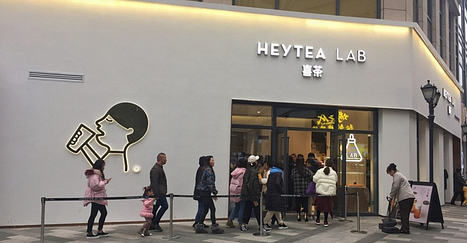
Moreover, Heytea launched “Go Stores” in popular business and office areas to manage customer flow better. Large QR codes for the WeChat app are prominently displayed, encouraging customers to scan and order. Within six months of launching, the app had more than 5.0 million users, a daily user count exceeding 185,000.0, and a repurchase rate of 300.0%. Interestingly, about 70.0% of WeChat-paying customers preferred ordering via the app rather than queueing in stores.
Heytea set up a VIP system for customers to improve user experience and interactions, which helps to increase rebuying to have more revenue.

Heytea also launched an online membership system and a unique “Heytea Intelligent Drink Taking Cabinet” developed over ten months to alleviate the strain of increased online orders and enable contactless pickup. By the end of 2020, “Heytea Go” had a staggering membership count of over 35.0 million, with 13.0 million new members joining that year. Most Heytea customers (about 81.0%) chose online ordering, with around 24.8% opting for delivery and 75.2% selecting in-store pickup.
In 2022, the membership grew to surpass 63.0 million, with 13.0 million new members joining alone. These members generated about 80.0% of Heytea’s total sales revenue. Compared to 2018, “Heytea Go” helped reduce the real customer waiting time by over 10.0 million hours in 2022. This surge in digital engagement has led to a 20.0% average increase in daily and monthly sales volumes since June 2022 compared to the previous year.
Heytea’s commitment to superior tea quality and a delightful user experience has significantly influenced this growth. The successful launch of new products such as fruit teas and milk-based drinks and collaborations with well-known brands have enhanced brand allure and customer satisfaction. For instance, a single store sold up to 2,600 cups of Blackberry Mulberry in one day, receiving a 98.0% satisfaction rating across the network.
Furthermore, collaborations with popular brands such as Hiroshi Fujiwara and Dream of China have spurred consumer excitement. Notably, the Dream of China collaboration sold 300,000 cups of “Perilla Peach Drink and Dream Tea” on the first day, setting a new trend for the TV show’s co-branded tea products.
Heytea’s digitisation has markedly enhanced the user experience and played a crucial role in its operational triumph.
Mi Xue Bing Cheng

Mi Xue Bing Cheng has been actively harnessing digitisation to enrich customer experience and improve efficiency. The company has seamlessly integrated digitisation into its manufacturing processes, allowing for automation, quality inspection tracking, and inventory control.
Furthermore, Mi Xue Bing Cheng has implemented Business Intelligence (BI) for more efficient data processing and extraction, providing a solid decision-making foundation. Its partnership with Guanyuan Data successfully digitalised inventory, goods, and memberships, which enabled the company to make more data-driven business decisions. They plan to enhance intelligent data analysis further and convert data into actionable guidelines for franchisees and store managers. Despite the increased workload, Mi Xue Bing Cheng focuses on improving customer experience and harnessing data for valuable business insights.

Focusing on data-driven user segmentation and understanding customer traits, Mi Xue Bing Cheng creates marketing campaigns that align with user characteristics, enhancing user retention. Additionally, their self-developed POS system immediately prints labels indicating the best before dates after opening the materials. This system also locks the label’s expiration date, ensuring traceability and control for every product sold.
Simultaneously, Mi Xue Bing Cheng has expanded its online delivery services, increasing their service radius. They have built their delivery capabilities through the WeChat applet, guiding more customers to transact in their private domain. This applet has become vital to Mi Xue Bing Cheng’s digital toolkit.
By displaying QR codes in their stores, they guide customers to use the applet for ordering and payment. It enhances the customer experience, reduces queuing time, and converts customers into digital members during registration. With a vast user base and detailed user profiles, Mi Xue Bing Cheng can analyse customer behaviour preferences more accurately. With backend data, they can detect customer needs, such as peak ordering times, favourite flavours among the 20–30 age group, and the average ticket size within office groups.
Mi Xue Bing Cheng has diligently leveraged digitisation to bolster customer experience and efficiency. It has strategised data-driven user segmentation and characteristic user identification, formulating marketing campaigns aligning with specific user attributes and boosting user engagement. A key innovation by Mi Xue Bing Cheng is their proprietary POS system, which ensures traceability and control for each product sold.
Mi Xue Bing Cheng ventured into online delivery to expand its services, extending its service radius. It has built its delivery capabilities using the WeChat applet, driving more consumers to transact within its platform.
Mi Xue Bing Cheng has also revolutionised the in-store customer experience by incorporating QR codes, which allow customers to use the applet for orders and payments. The strategic move minimises queuing time and converts customers into digital members during registration. As a result, Mi Xue Bing Cheng can leverage its extensive user base and detailed user profiling to undertake a granular analysis of customer behaviour and preferences. It includes insights into peak ordering times, favoured flavours among the 20–30 age group, and spending habits of office groups.
While product quality and ingredient selection aren’t the main competitive advantages for Mi Xue Bing Cheng, their focus on digitisation enhances the user experience. It fosters customer loyalty through innovative marketing strategies.
By analysing consumer behaviour data, Mi Xue Bing Cheng can swiftly understand user ordering times, beverage choices, taste preferences, and preferences for fresh drinks and ice cream products due to regional and seasonal factors. These insights enable Mi Xue Bing Cheng to launch new products that align with consumer demands and develop specialised equipment to enhance operational efficiency.
As part of their digital marketing efforts, they have executed a well-strategised marketing channel design:


Videos related to “Snow King” have amassed over 2.0 billion views, and the “Mi Xue Bing Cheng” theme song has been played over 2.0 billion times, according to their prospectus. On the TikTok platform alone, “Mi Xue Bing Cheng” topics have over 1.4 billion views due to user-generated content. The buzz around “Snow King Blackening” in 2022 led to the revelation of the summer launch of “Zhi Zhi Sang Berry” and “Sang Berry Berry”.
The digitisation efforts of Nayuki, Heytea, and Mi Xue Bing Cheng have significantly improved user experience in the new-style tea beverage industry. Nayuki’s adoption of digital systems, such as the Teacore platform, has streamlined operations and enhanced product offerings based on customer preferences. Heytea’s integration of ERP systems and digital tools has allowed for tailored strategies and improved customer engagement through the Heytea Go applet. Mi Xue Bing Cheng’s focus on digitisation has improved efficiency and enabled data-driven decision-making. However, the challenge of long customer waiting times remains a pain point that requires further attention.
III. Future Trends and Opportunities in Digitisation for the New-Style Tea Beverage Industry
As the new-style tea beverage industry embraces digitisation, some exciting future trends and opportunities can further enhance the user experience. Emerging technologies in the digitisation space offer promising advancements for industry players to explore.
One pain point in the industry is the long waiting times due to manual operations in certain aspects of the production process. The sector can consider leveraging data-driven operations to improve production efficiency. For example, the digitisation process can help to optimise the whisking and automated packaging of milk caps. Businesses can enhance production speed and accuracy by implementing data-driven automation, reducing customer waiting times.
Additionally, using user location data and analytics allows for adjusting the drink preparation order based on customer arrival times for in-store pickups. By analysing customer location data and the estimated arrival time, businesses can prioritise the preparation of beverages based on proximity, ensuring that drinks are ready when customers arrive. This personalised approach can significantly improve customer experience and reduce waiting times. For instance, the founder of the coffee brand 25COFFEELAB requires that all baristas determine the timing for making coffee based on the delivery rider’s location provided by the backend system.
Furthermore, businesses can define adjustable and automated production lines by leveraging data to identify popular products. Drawing inspiration from successful implementations, such as Luckin, increases efficiency and reduces waiting times through these adaptable production lines. By continuously monitoring data on product popularity and adjusting production accordingly, businesses can streamline operations and meet customer demands more effectively.
The predicted impact of these technologies on the new-style tea beverage industry is substantial. Implementing data-driven operations and automation improves production efficiency, reduces waiting times, and enhances overall customer satisfaction. Businesses can foster greater customer loyalty and engagement by delivering drinks faster, ensuring order accuracy, and providing personalised experiences. These advancements also offer cost-saving opportunities and enable businesses to scale more effectively.
Overall, the future of the new-style tea beverage industry lies in the continuous exploration and implementation of digitisation initiatives. By embracing emerging technologies and leveraging data-driven insights, industry players can unlock new opportunities to enhance the user experience, drive growth, and stay at the forefront of this dynamic and evolving market.
IV. Conclusion
In conclusion, China’s new-style tea beverage industry has experienced significant growth but faces challenges such as long waiting times that can hinder the overall user experience. To address this, companies like Nayuki, Heytea, and Mi Xue Bing Cheng have embraced digitisation to enhance operational efficiency and improve customer satisfaction. Through adopting technologies such as automation, data-driven decision-making, and personalised experiences, these companies have successfully streamlined their operations and tailored their offerings to customer preferences. However, long waiting times remain a pain point that requires further attention. The industry has opportunities to leverage emerging technologies like data-driven operations and location-based analytics to optimise production efficiency and reduce waiting times. By implementing these advancements, companies can enhance the user experience, drive customer loyalty, and achieve sustainable growth in the new-style tea beverage market.
V. Reference
2022年上半年中国新式茶饮行业发展现状与消费趋势调查分析报告, iiMedia
为什么喜茶被称为数字化奶茶?看了这些你就明白了, Sohu, 14 Mar 2020
喜茶,强大的数字化运营能力拆解, 19 Apr 2023
喜茶的骗局:2000万私域流量,一杯数字化奶茶, 6 Mar 2020
内卷数字化:蜜雪冰城要投2.7亿,瑞幸咖啡花了15个月|氪记 2022, 36Kr, 10 Jan 2023
观远数据对话蜜雪冰城:数字驱动是茶饮品牌未来发展的长线, China Daily, 25 Feb 2020
奈雪的茶:一杯奶茶中的数字化”秘密”, InfoQ, 28 Nov 2022
Digital transformation, the life-saving strategy of enterprises in the epidemic, Ruiqi Niu & Qing Zhong, May 2022
喜茶十年:冷思考与新启动, Tech时代, 11 Jan 2023
喜茶发布十周年报告,下一步全面走向大众市场, Sina, Jan 2023
新茶饮远离星巴克:依然需要第三空间, Sina, Sep 2021