Tuesday, March 8, 2016

Change or be changed


Singapore must take a leadership role in so-called disruptive technologies like third-party apps such as Uber and GrabCar. If we do not innovate and create disruptive technologies, we may not be well placed to react to global trends in time, to our detriment. We have seen how Uber disrupted the taxi industry. Years earlier, data-based messaging services such as WhatsApp disrupted the SMS business. Paypal and mobile payment systems eroded the retail businesses of banks.

Some countries with more resources and a larger domestic market may be able to withstand such blows, and mitigate these effects of disruption at later stages. Singapore does not enjoy such luxury. We must be at the forefront of these disruptive technologies. In the case of Uber for example, it would be very much in line with our economic strategy to persuade Uber to move its Asian headquarters to Singapore.

Some still hold the view that we can resist such technological disruptions, such as through regulatory legislation, in order to protect local interests. We would only be creating inefficiencies, and allow the world around us to move ahead.

The process of technological disruption will be painful. Admittedly, disruption may threaten some jobs. But if we can lead the way, we create for ourselves more time to mitigate the effects of any such negative socio-economic situations. This is a crucial learning process helps to boost our resilience towards potentially catastrophic changes, which are beyond Singapore’s control anyway.

The next frontier for disruption would be the service industry, especially within the F&B sector. Eatsa, a high-tech fast food restaurant recently opened in San Francisco. Eatsa revolutionaries the dining experience with full automation of almost all processes in a F&B business, especially in serving food and cashiering. With the exception of a few kitchen staff, there is not a human in sight. The restaurant has received good reviews. This marks a new era — technology has begun disrupting the low skilled service industries.

Singapore’s service industries currently requires a considerable low-skilled labour force. This has all sorts of political ramifications with regard to debates on immigration, which sometimes borders on xenophobia. Disruptive technologies like what Eastsa is pioneering is therefore the natural way forward.

Policy makers cannot shield Singaporeans from these changes. Singapore and Singaporeans will be worse off, if we over-regulate such technological innovations. It makes more sense for us instead to adapt to such changes. Beyond adapting to changes, we will also need to take the lead in the disruption of established industries.
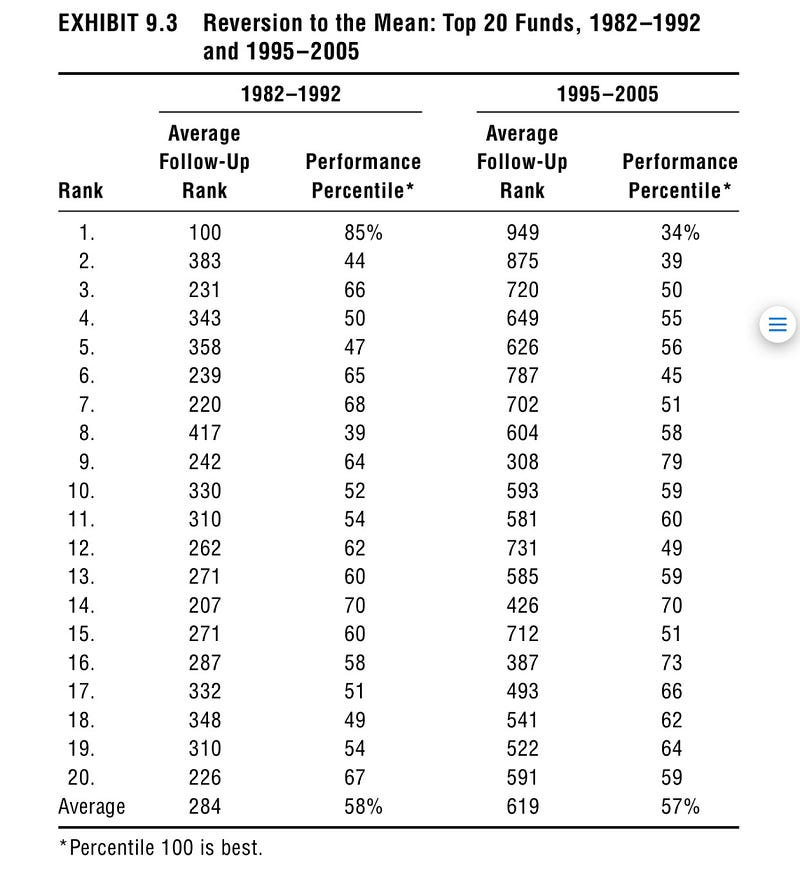
Regression to the mean

I want to talk about regression to the mean because this will transform the investment industry.

Look at the table above. Well performing funds do not stay at the top. They revert to the mean. This implies if you had bought a fund simply because it made good results in the past, you are more likely to lose. Simply put, if you came first, overtime you will underperform to emerge somewhere in the middle (the mean).

I get it that many professionals tell you they have insights. They print beautiful brochures. Anyone can report good results. Think about it this way, you came in 20th in a class of 40th. How do you show you did well? Well, you can say you were top 5 of those who went to the same club as you did. You could also say you were first in the entire neighborhood you stay in. These could be facts. But it does not take away the fact that you only came in 20th.

  • Fund performance is hypothesized to be random
  • Cost and fees are everything. Buy the cheapest that gives you the broadest diversification
  • Please buy funds yourself, direct, not through advisors. They take a big cut


Tuesday, March 1, 2016

Con men and cheaters who teach you how to trade for a lot of money

Many errant businessmen are selling trading courses. No one with a working formula will reveal their “magic formula” for a few thousand dollars. The efficient market hypothesis states that any formula that takes, if released into public hands and if adopted by the public, will result in the nullification of the effects of the formula.

But the case is different if the formula is one based on simple probability. 50% of the time it works, 50% of the time it does not work. You sell the formula for thousands, show the cases when it works, find a reasons when it does not. Offer advice on hindsight, give many caveats for future looking tips. This is an old business. People have sold gambling tips over centuries. Today, the same con men are legitimizing this trade by dealing with regulated instruments like stocks.

Let me unveil the business model. They get you in to attend a free course, hype you up, sell a 3 to 4 day course for thousands. At the end of the course, they sell you more courses and formulas and unique programs. You get sucked into the program. Just when you think this is it, there’s more. You signed up with one of the brokers they brought. Every trade you make, they make a fee, or at least, they earned an introductory fee.

If you want to learn how to trade FX or stocks, read a proper textbook. There is no short cut. Keep a few honest financial blogs. There’s not many.

Saturday, January 30, 2016

Is MP Desmond Lee right about our crime status in Singapore?


Is MP Desmond Lee right about our crime status in Singapore?

MP Desmond Lee said that Singapore achieved low crime rate with a lean police force comprising 9,400 regular police officers. He added that this was low compared to other cities such as London, New York and Hong Kong. However, he did not indicate whether crime rate had increased or not.

The mid-year crime statistics released in August 2015 (16,575 cases) was 6.7% more than that of last year during the same period. In the previous year, crime in 2014 increased by 7.4% from 2013. Does the MP think that as long as we have an efficient police to crime rate, Singaporeans can tolerate crime increases?

In a Parliamentary reply in February 2014, we found out that we have about 6000 auxiliary police officers. Perhaps our police force is not so lean after all. 

Monday, January 25, 2016

Secrets to buying insurance

Should I buy from a friend or direct?
Try not to buy from an adviser because insurance commissions can be very high. Yes, it can go up to 50% for your entire first year’s premium. This is why you should go online to get one yourself. Simply Google “Compare Insurance” to find out portals that can help you spot the cheapest coverage.

How do I shop for insurance by myself? I don’t even know what is needed?
There are just a few categories of insurance.
  • Health insurance mitigates the risk of falling sick – I recommend to upgrade to cover private hospital expenses
  • Life insurance – I recommend to cover your projected income until the age of retirement. By retirement you won’t need insurance because your savings is supposed to take over. Frankly, if your family is wealthy enough to survive should you pass on, forget about this.
  • Critical illness – I like this. Buy this because you don’t want to be a drag to your family when you are critically sick. Note that both euthanasia and suicide is illegal in Singapore
  • Buy term insurance. They are cheaper. Do not buy wholelife or ILP. There is, however, a special case for ILP where you can choose to maximise coverage and use the rest of the remaining units to invest (very little).

Honestly, the products that an adviser sells you won’t be able to help you retire well. You need to seek higher income and, perhaps, work harder. 

Thursday, January 21, 2016

Technical and Fundamental analysis can be different but both helps the investment process


Technical analysis and fundamental analysis are two different schools of thought. There are polarizing. In an efficient market, technical analysis should add no value.

Technical analysis is based on the belief that the market is not efficient. Technical analysts use indicators that are independent of the company’s financial condition. Fundamental analysts focus on the financial health of companies. Fundamental analysis chooses stocks to buy; technical analysis chooses when to buy for analysts who use both. Proponents of strong form efficient market theory and technical analysts are at opposite ends of the philosophical spectrum. – CFA Magazine

But I think there are times when the market is inefficient. This is when technical analysis is useful. More fundamental analysts are checking their charts. Charts provide a good overview of the markets.
Technical analysis is related to stock price and volume, whereas quantitative is statistically based, using excess return forecasting and fundamental indicators such as earnings, earnings trends estimates. Quantitative analysis assumes that an investment philosophy can be expressed as a statistical model.

Monday, January 18, 2016

Don’t fall for the tricks of advisors, buy the index fund


I hope to simply the process of investing among individuals. The investment sector is filled with fraud. As long as you buy or sell, someone makes money from you. And the world is consistently asking you to buy or sell. No one ever tells you to buy and hold forever, even though that’s the best strategy to induce the least cost.

I’m going to sure a few tips that you will find boring. But it’s going to save your life.
First, invest in an index fund. Never ever buy any collective instruments if possible. Any active managed fund will cost you an arm and a leg compared to a passive index fund. Run from anyone who tells you you can beat the market. No one can. If there is actually a fund with a superior strategy, it’s never going to last long before the market neutralizes it. Most likely you earn normal returns after cost.

Do not fall for simulated results. Be aware that most fund houses present results from a pool of funds they select – we call it survivorship biases. No one ever beats the market. There are great investors who existed in the past. But after taking their returns, adjusted by risk, the risk adjusted return also cannot beat the market over the long term.

Just buy the index fund. Please do not fall for tricks and sweet talkings.

Run from advisors who tell you they can beat the market!


I hope to simplify the process of investing among individuals. The investment sector is filled with fraud. As long as you buy or sell, someone makes money from you. And the world is consistently asking you to buy or sell. No one ever tells you to buy and hold forever, even though that’s the best strategy to induce the least cost.

I’m going to sure a few tips that you will find boring. But it’s going to save your life.
First, invest in an index fund. Never ever buy any collective instruments if possible. Any active managed fund will cost you an arm and a leg compared to a passive index fund. Run from anyone who tells you you can beat the market. No one can. If there is actually a fund with a superior strategy, it’s never going to last long before the market neutralizes it. Most likely you earn normal returns after cost.

Do not fall for simulated results. Be aware that most fund houses present results from a pool of funds they select – we call it survivorship biases. No one ever beats the market. There are great investors who existed in the past. But after taking their returns, adjusted by risk, the risk adjusted return also cannot beat the market over the long term.

Just buy the index fund. Please do not fall for tricks and sweet talkings.

Saturday, January 16, 2016

Smart Beta are faddish. Go back to Index Funds


These years we are seeing a proliferation of smart betas. The intention of smart betas is to create alternative weighting schemes beyond value / market weighting. Smart betas can be weighed according to their risks or any other characteristics that the fund manager chooses. For example, if we believe that smaller firms outperform larger firms, a smart beta fund can simply inverse weight the firm –  a small firm gets a large weight, a big firm gets a smaller weight.

To me, a smart beta is simply an active management instrument simplified. In the past, managers can decide which stocks to be included in their fund based on stock characteristics. But a smart beta stock uses algorithms to weigh each stock according to the fund manager’s assessment. Because it is rather automated, the fees are lower than traditionally managed active funds.

But they fact is that these smart beta funds trade too much to re balance according to these “novel” factors. A value weighted index re balances just once or twice a year. These factors used to develop smart betas are decades old. They are typically the same factors known to the public comprising value, momentum, quality and size. It is challenging to understand why anyone would pay anymore money to smart beta funds to get exposed to these factors when there are much cheaper value weight indexes out there. For example, if you wanted to have exposure to smaller firm index, do not use a smart beta fund. Simply long a value weighted index that is made up of smaller firms.

Let’s go back to the basics of portfolio management – minimize risk per unit of return. The best portfolio is one that lies on the capital market line which the entire market in one portfolio. Perhaps you can read this article. If you wanted higher returns the simpler method would be to invest in the market index fund and use leverage to enhance the return. It is clear that the smart beta fad will be a passing one. Investors must continue to follow what John Bogle says – just invest in the simplest cheapest index fund.

Thursday, December 31, 2015

Wealth management is a complex process


Should you invest in ETF?

Wealth management is a complex process of defining the client’s needs and designing a portfolio that is rightly exposed to meet the client’s requirements over a very long time. Most may confuse the definitive of wealth management and wrongly consider wealth management as stock selection. The latter has a scope too narrow and can be dangerous.

There is a huge ecosystem of professionals support the wealth management industry. Wealth managers are a critical person in the process. They determine the investment objectives and finalize the weighting targets for the individual portfolio’s targets. This process of finding the right instrument is carefully led by the pre-determined investor’s IPS — investment policy statement.

Determining the IPS is the first and most important step. A good IPS will mitigate the risk of the portfolio. Imagine the IPS as the parameter of your house. You draw clear parameters to ensure your family members do not cross over the line and be exposed to danger. A fund manager may have multiple interesting investment opportunities, some of them may possess unique risks that cannot be easily diversified in the context of your portfolio. A group of random collections, all promising high returns spell danger and volatility.

Investors have unique characteristics and different IPS. A retirement fund may have a time horizon of 20 years and prefer income to capital gains. A growth portfolio may have a longer time horizon of 50 years to fund the young executive’s savings. The growth portfolio will require a mix of high risk products. The same investment prospect cannot be equally considered for two different portfolios.
Given the complexity, the first goal of the investor is to select a highly skilled and persistent wealth manager. This is not a straight forward task. More than 80% of managers do not beat the market. An investor that prefers the cheapest investment strategy that outperforms most fund managers will be automatically attracted to the index fund investing. Index funds replicate the performance of benchmarks and do not make an attempt to outperform. Given the non-discretionary decision to replicate the market, professionals label this strategy as passive management. The benefits of passive are clear. Firstly, this strategy is simple and does not require complex selection of managers and determining of IPS. Secondly, the simplicity implies cheap fees since managers are not paid exorbitant incentives to outperform he market.

Investors need to make an informed choice between two options.

1. Adopt a more active process to select managers and to determine the investor policy statement and 

2. Invest in a non-discretionary equity index fund.

Annuities and Retirement Planning — Longevity Risk


A closer look at annuities and retirement planning in the context of Singapore

Annuities get very little respect because they are portrayed as expensive and loaded with sales fees. However, a rapidly aging demographic and declining real wages has jeopardised the current projections for government led pension plans. It is not easy to supplement retirement with private wealth management plans because the state cannot mandate how much citizens save beyond the scope of pension policy.

Life annuities are crucial because they hedge against longevity risks and medical expense risk. In fact, annuity payments should be inflation indexed. Life annuities have monthly payouts. The stream of cash flows can be replicated by a mix of bond payments. It does seem like bond yields may no longer be able to match up with the required annuity yield. To meet the annuity payouts over a longer time, annuity managers may need to introduce risky products like equity index funds into the portfolio. But it is unclear if citizens are open to endure the high risk.

In Singapore’s context, I am less sure if Singaporeans are preparing for longevity risks. Should they expect to systematically live longer, to say, 90 year old, the consumption save must reduce tremendously. Practically, a young professional who expects to live till 100 will need to start investing in equities as soon as he starts work.

It is incorrect to think that life annuities are expensive products if we assume Singapore is a competitive market for annuities. In a competitive market, we can assume that longevity risks and recent demographic trends are priced into these financial products.

There are ways to reduce premiums for annuities. The larger the insured pool, the lower the premiums. For one, the fixed costs will be reduced. The pooled risks approach a normal probability curve. This implies that Singapore government’s mandatory annuity policy is in the right direction from a policy point of view. But the policy makers should introduce the annuity programme with a softer approach. Perhaps annuities need not be made mandatory right at the start. In fact, the government can communicate the benefits of annuities and highlight the financial risks of not subscribing to an annuity.

Risks of the ETF in the near future


There are fears that ETFs will be the key contributor to the next financial crisis. ETFs now take up a huge percentage of retail and pension investments. Some suspect that the ETFs will lead the market instead of mirroring it. Lack of liquidity within ETFs may cause rapid selling of ETF units, destabilizing the general stock market.

Another concern is how over-levered some ETFs are. There are also complex ETFs that are leveraged, synthetic and inversed. It is not clear yet that the impact of these instruments on the overall markets when prices become unstable. For far too long, ETFs have been the cool kid on the street. Investors have ignored the voices of some who share the adverse side effects of ETFs. It is well known that the ETF structure is unique, requiring units of ETFs to be created and to be tracked according to the market. The creation and marking to market of the ETF is a constant arbitrage exercise. Not every ETF is liquid and simple. Some ETFs mirror complex markets like junk bonds, loans and less familiar municipal indexes.

Finally, ETFs when leading the market is a representation of herdish behaviour. Afterall, every ETF investor invests in the same market within the same ETF product. For some, they have preferred index funds over ETFs precisely for fear of the ETF structure.

Little known truths about the investing community


Net return received by investors is net of cost. There are many types of costs. Some are clear, some are hidden. Our financial system is complex. There are too many middlemen, the leftover returns for the common man can be too little to sustain savings. Investors (you) becomes the bottom of the priority list.

Investors commit money and get exposed to risk. If the market moves in your direction, the hedge fund manager takes a large chunk of your wins. If the market moves against your direction, the manager is insulated from losses. He still takes a fee from you.

Benjamin Graham said that anyone can design a strong portfolio with just stocks and bonds that are representative of the market.

A do nothing policy is always better than an active strategy. As long as you make a decision to move money, someone charges a fee. If I may summarize, always invest with the lowest cost instrument - index funds.