Friday, April 7, 2017

这些锅,激情不背


2015年6月,乔布斯在斯坦福大学的毕业典礼上做了一个举世闻名的演讲。他分享的其中一个杰出的理念在不同年代的人心中都引起了共鸣:

“你要找到你爱的东西……做伟大的事情的唯一途径是真正爱你所做的。如果你还没有找到,那么继续寻找,不要停下来。”

我相信,所有爱着自己工作和行业的人会同意激情在培养你的动力,帮助你在枯燥中获得乐趣和困难时为你带来正能量上发挥了极其重要的作用。然而,激情是一切的顶梁柱还是一切的终点?

大概在十年前,Y世代的周围充斥着鼓励你跟着感觉走的大量信息,整个大环境告诉他们,只要你勇敢跟随激情的方向,只要你坚持信念,胆识过人,钱不会是问题。

作为一个相信快乐促进职业发展的人,我必须严肃地声明,这句话具有危险的误导性。诚然,如果你每天都可以做你喜欢的事情,你的生活会洋溢着愉快的气息。

但是,激情这两个字,不做背锅侠。

激情从来不是你创业的原动力。可能你不想总是被命令所以选择命令别人,但是这不叫做追随激情。

首先,你喜欢做的事情很有可能在企业里面做,经常还可以得到前辈的指引。就算你有幸进入了你喜欢的岗位,难缠的老板,恶心的企业文化,自身发展和公司前景矛盾等等的问题随时会发生,到处都在发生,把原本你对于职业生活的美好想象和憧憬无情打破。

其次,就算你的梦想的确是拥有自己公司,你也一定会有客户,他们对你公司的业务和发展起着决定性的作用,你眼巴巴地希望他们可以对你满意。归根结底,你也还是有老板,并不是无拘无束无比轻松的。

顺便提一句,我觉得尽管我们是受雇于别人,我们仍然可以是自己的老板。不管我们在职场中的地位高低如何,不管我们处于什么样的环境当中,我们都应该清楚地知道如何自我督促和自我激励。这是态度问题,同职位无关。

所以,如果你只是不喜欢被别人带着,指向的结论不应该是辞职然后所谓“追随激情的脚步”去开公司——除非你本来的梦想就是自己创业——而应该是你首先要重新审视自己在工作中与人交往和相处的能力。

私以为,我们这个时代的才艺秀太多了,而且都被精心包装成了真人秀节目。要创造节目效果并不一定要扭曲事实和参与者的真实形象,只需要加点料或者只告诉观众一部分真实就成功了。观众的深陷其中,加上凶猛推手的操纵,例如营销号的推送和公关团队的运作,联合炮制出了一大锅自以为是的成功学鸡汤,涉世未深的年轻人以为这是正常风气,是追梦路上的必经之路;小有成就的那一撮人面对晚辈的饭桌上就有了谈资,最后真人秀节目组都因为这种热炒赚足关注度,名利双收。就比如那些看起来很燃的话:

“我就要唱歌!”

“当我十岁的时候收到一双舞鞋作为生日礼物,我就知道我这一生和舞蹈分不开了。”

这个时代的人们越来越相信,弄清楚自己喜欢什么就像是找到神秘宝藏或是同灵魂伴侣相伴一生的童话。当我们经历了数不胜数的失败后,终于对某样东西有了激情碰撞的火花,沉浸在找到归属的陶醉感觉中久久不能平复心情——以至于我们认定它是那么的无可替代,这一生都离不开它了。然而事实上,和很多人都说他们对什么都不太感兴趣的逻辑一样,我坚定地认为,人都会喜欢超过一样东西。实际上,那些说不知道他们对什么感兴趣的人应该是挺纠结的,因为他们享受的事情太多,并没有说喜欢某一个甚于其它的。

除了一个人可以有很多兴趣这个情况,我也相信兴趣可能会越来越多。一些大器晚成的典型人物,在很多人眼中,成功的模式是“穷极一生终于找到了自己喜欢并且适合的方向”。但是他们在其它领域活动时候的状态,是终日碌碌无为得过且过还是和改行之后一样勤勉,在他们的回忆录出版之前很少人知道。如果情况倒过来,他在前一个领域已经享誉国际之后,再转向其它方向,比如担任皇家造币厂厂长的物理学家牛顿,我们说他不断挑战不断进取。其实,不论是在什么地方哪个领域,他们很有可能一直都保持着认真专注,坚持学习的习惯,他们的成功和找到自己的兴趣所在没有联系,有可能是把热爱又延伸和扩大到了另外一个领域。然而很多人却津津乐道于时间上的微妙关系,随意揣测背后的故事而忽略让他们成功的优秀品质,不得不说这是一种思维和行动上的偷懒。

很多人都太高估热情和理想的力量,认为只要怀揣着理想信念和一腔热情,多枯燥多困难的工作都可以像度假一样轻松愉悦,没有烦恼。有人甚至说,希望有更多的空闲时间来享受生活,最好一周只工作四个小时。

抛开喜不喜欢有没有激情这个问题,每个人都是会疲惫和沮丧的,各行各业各岗位都会有自己的烦恼和辛酸。一旦你认为当下的工作太辛苦,那你一定是被困难和障碍吓倒了,工作热情不是你应对客观存在的问题的护身符。

“工作生活两平衡”和“跟随激情”之间没有任何相关性,更谈不上因果性了。一个讨厌自己的工作的人也可以总在最后期限之前完成工作,并且不耽误运动,娱乐,和家庭聚会的时间。有些爱一行干一行的人在时间和生活管理上是失败的,尽管他们时间上自由,工作空间也足够。他们有时候倾向于过度工作,然后下一次又工作时间短一些,但这又引起了心中的愧疚感,于是第二天拼命工作,如此恶性循环,他们没有时间做其他事情。

假如你是一个自由职业者,几乎足不出户,我想你是不会抱怨工作生活不平衡的。平衡是一个关于理清本末主次的命题,关键在于制定好自己的计划。处理好工作生活的平衡纯粹是一项可以习得的能力,和你是雇主还是雇员,你是喜欢还是不喜欢你的工作没有关系。

假如你幸运地投身于自己喜爱的事业当中了,生活中该出现的问题和麻烦还是会出现。亲人离去,遭到拒绝,遭遇失败,爱情实力,生病,这些都是生活中铁定会出现的烦恼,并且任意一个都有可能成为压垮你的最后一根稻草。你的工作热情在蜜月期之后的消退,也会让你眼前的这份工作和世间其他工作没有什么区别,不再像以前那样闪闪发亮,你眼中更多的是负起责任。

在职业生涯刚刚起步的时候,遇到失败挫折甚至方向上的动摇的风险很大。有幸从事自己真正喜欢的工作并不意味着在被困难打到之时,你会毫不犹豫来一个充满力量的鲤鱼打挺站起来。

除了“发疯似的向前冲”,让你重回正常轨道的不是你对于工作的热情,而是找到“为什么我想要做这件事”的答案,而不是“这件事”,热情比你想象中的更容易被打败。与其说这是让自己的原因更加明确,不如说这是让自己比以往更加看清自己的目标。

有人说他们对什么都感兴趣,也有人说他们对什么都不感兴趣。不管是哪种情况,我都深信激情存在的意义不是让你盲目去跟随。看到自己的激情是你有可能有能力创造出伟大的东西的信号,这很好!

激情负责必要时候创造趣味,它为你朝着目标行进的时候布置愉悦的气氛。在艰难看不到尽头的职业生涯中,它至少支持着你去面对未来的不确定性,虽然不能支持着你在挑战中一定不被打败。

激情可能会是路上的一个重要工具。但是,仅仅依靠激情是不足以成功和满足的,还需要其它东西,比如能力,执着,不断地工作,适当的人脉,甚至合理的时机。最重要的是,出于正确的原因追随你的激情。​​​​

Monday, March 6, 2017

The perils of naïve diversification


Many investors buy into a large number of funds to achieve diversification. The assumption is that the more stocks or funds they hold in the portfolio, the better the diversification.

This is wrong. Two funds can have huge overlaps. For example, a value weighted fund covering ASEAN and another covering Singapore will achieve minimal diversification. The top holdings in the ASEAN fund will be from Singapore anyway. In this case, it is much better to own 2 funds without overlap – a European fund and a Singapore fund, for example.

The case becomes more complex when the number of funds increases. You can own more than 10 funds, but have less diversification than another investor with 3 simple, non-overlapping funds. 
Here’s another example:


  •       Global equity fund
  •       U.S equity fund
  •       Dow Jones equity fund
  •       NYSE equity fund
  •       Global financial fund


These 5 funds will have huge overlaps. We know the biggest firms are listed in the U.S and may also be domiciled in the U.S. The largest firms may also be on the Dow Jones. Most importantly, firms in the U.S, on the Dow Jones and listed on the NYSE are likely highly correlated anyway.

We could build a simpler portfolio with much higher diversification benefits with a Japan fund, an Indonesia fund and a US fund.

Here’s a real example: CIMB FTSE Asean 40 ETF (SGX:M62) claims to invest across ASEAN. But the fund holds close to 30% of Singapore financial and telecoms stocks. Close to 70% of the fund is concentrated in financials and telecoms. This ETF is not diversified sufficiently across ASEAN.

A much better alternative to achieve ASEAN coverage is to buy ETFs covering ASEAN nations, or stocks of ASEAN nations.

Investors should read fund prospectus and avoid naïve decisions in investments.

Sunday, March 5, 2017

Active management shrinks under index funds' pressure


Passive indexing is taking out more AUM, from active management. This trend is unstoppable and it is only right. Retail investors need exposure to very cheap, non synthetic, index funds.

Aberdeen recorded its 15th consecutive quarter of net outflows last month.

Amin Rajan, chief executive of Create Research, the asset management consultancy, said: "The threat from passives is keeping CEOs awake at night."

Friday, March 3, 2017

The diminishing role of investment researchers


As passive investing grows, the need for discretionary investing services reduces. This is especially so for retail investment. For smart money, quants introduced smart beta, automating unique factor loadings. In both cases, the picture of an analyst in front of a laptop with his valuation model may cease to exist in the long term.

Research firms charge six figure sums for their services. These fees are loaded into funds. Fund managers can choose to hug the index and lower the cost, casting responsibility of performance to the market, or pay for such services and try to outperform the market. The choice is clearer in these days. A wide majority of funds fail to beat their benchmarks persistently. The number shrinks over a longer horizon. To lower costs, fund managers are more likely to give up these services, whose value is harder to ascertain, than other stickier expenses (e.g. bonuses and salaries).


Buffet, Bogle and the late Ben Graham advocated index investing. They assumed the market was efficient. Based on decades of investment returns, they seem to be right. In this case, most researchers are unlikely to add to the discovery of alpha. Perhaps they can create a healthier ecosystem by discovering fraud and dissecting financial info. But the role of creating information is quickly being disrupted by data analytics and social media. Alipay’s Sesame Credit analyzes trustworthiness by the data they collect from customers – their buying and selling patterns, their credit decisions and social media behaviour.


My take is that demand for investment researchers will decrease. 80% of sell side reports do not add much value. Charting of financials and repeating press releases simply do not make the cut anymore. The few star thinkers will continue to command high pay in buy side. Like logistics, e-commerce and payments, the research sector will likely be disrupted.

Sunday, February 26, 2017

A position of rest - minimalism


平和是一种姿态

最烦人的正是所谓"小事"。上班路上的堵车,各种噪音和烦闷的环境都在掐死我们原本平和的心境。当我们不再平静的时候,也会尝试着去努力稳定自己的情绪。而当情绪终于也失控了,人就会完完全全被周围环境支配。我们开始更在意其他人,于是会毫不犹豫地回应他人的冒犯。而在内心平和的时候,我们思考的更多的是别人动机和目的,而不是别人怎么看自己怎么想自己。

怎样才能达到内心的平和?内心平和不依靠外界获得。平和是一种哪怕外界正在拼命消耗和掏空我们的时候,我们仍然可以保持和平衡自己的状态。如何保持平和的心境?主动减少自身肾上腺素的分泌,平静的方式去工作。肾上腺素激活情绪,点燃怒气,让我们变得就像猛兽盯着猎物一样,随时会出击。如果我们总保持着肾上腺素满格的状态,它带来的压力是致命的。肾上腺素有很有用,但是平时一般都用不到,战斗或者逃跑的时候可能用得上。但是我们的常态,是保持平静。

平静的而不是心神不宁的心境中工作很重要。不论是做什么,都要让心境不受打扰,远离忧虑。哪怕是DDL临近,也要平静地工作。压力对清晰的思维和更高的效率毫无贡献。平和是一种姿态。任何时候都不要让自己进入焦虑的状态中,和负能量的朋友保持距离,不要和总是批评指责你的人结婚。

爱自己,就从停止焦虑开始,把那些烦扰的小时减到最少,让平和的心境不断延伸。

Working from a position of rest

We may get frustrated by many little things in life. On the way to work, traffic jams, noises, distractions can affect our peace. Without peace, we may feel to control our emotions. When we are unable to control our emotions, we get affected by the environment. We react to people's insults, we take people too seriously. With inner peace, we enlarge our people motives - lesser of what people think and feel of us.

How do we achieve peace? Peace cannot be given to us by others. Peace is a state that we maintain within ourselves even when others try to rob us of it. How do we maintain peace? Reduce adrenaline, work from a position of rest. Adrenaline pumps up our mood, it makes us angrier and adrenaline gives clarity, just like an animal hunting for food. Adrenaline is not the usual state of mind. Stress resulting from adrenaline kills if we allow adrenaline to fill us up often. Adrenaline has its uses, but it is not the usual state. You need it in a fight or flight situation. But always maintain a position of rest.

Working from a position of restfulness not restlessness is important. Whatever you are doing, let not your heart be troubled. Let not your heart be stressed. If you are near a deadline, work from a state of restfulness. Not an inch of stress can help you thjnk cleaner and work faster. Yes, rather lose your job than get stressed daily. Rest is a position. Do not allow yourself to get into a position of stress. Simply avoid friends with negativity. Do not marry the guy who convicts and condemns you.

Love yourself. Start everything from a position of stress. Minimize the smaller things in life, enlarge and bring to importance peace.

Sunday, January 29, 2017

Investing in Singapore


Many cheaper tools in the US and U.K. don’t exist in Singapore. Robinhood App, an application that provides free trading is not yet in Singapore. Commissions for trading in Singapore is still expensive which minimum $30 (including GST) per trade. In US, many brokers don’t charge a minimum.

Why are these important considerations? Cost is an extremely important factor. But even without these cheap tools, there are ways for us to remain competitive. Here are a few rules


1.Don’t buy actively managed funds. There’s plenty of literature on how active funds don’t outperform their market benchmarks.


2.Buy cheap. Always use the cheapest providers. In Singapore, go to the exchange and buy simple ETF products. Going through an expensive intermediary will be incredibly expensive. Why pay more than 0.5% annual expense on active managed funds?

3.Know that actively managed funds regress to the mean. I.e, hardly any actively managed fund persistently outperforms the market.


What does this mean? Buying a combination of funds through an intermediary will not be your best move. Think about the fees you can save if you invest through a simple broker on the capital markets. Here’s a short article on how to invest in ETFs.


For more such articles, follow www.seekingreturns.com

Thursday, November 17, 2016

Active funds: frequent underperformance, higher expenses and underrated risks


The scale of passive funds is growing. Passive funds now account for 32.5% of US assets managed in mutual and exchange traded funds. According to data from Morningstar, $223.1 billion outflowed from actively managed funds; meanwhile, passive funds saw inflows of $418.6 billion in 2015.

For the year 2015, 66.1% of large-cap managers, 56.8% of mid-cap funds and 72.2% of small-cap managers underperformed their relevant S&P US benchmarks. Over long time periods, 82.1% of large-cap funds and 88.4 % of small-cap managers fail to match their benchmarks. Of all the 678 domestic equity funds in the top quartile for performance over the year to September 2013, only 4.3% stayed in the top quartile by the end of September 2015. This means very low persistency. 

There are two ways to earn higher returns: to find an excellent manager or an unbeaten strategy or to reduce the cost. It is proven that the former is easier said than done. On average, active funds will roughly match the index before fees; that means that after fees, most of them will lose to the index. Style Research’s survey provided evidence for it. Among 425 global equity funds, 31% of them outperformed the MSCI World. Without taking any costs into account, however, 59% of representative samples beat the index. That is to say, 28% of funds charged too much to maintain the beat-the index performance.

For those that do manage to outperform, size can become a problem. Strong performance attracts more money and larger funds find it much harder to beat the market. A research by Stambaugh found that the scale also affects performance and that a more skilled large fund can underperform a less skilled small fund.

Sunday, November 13, 2016

Is there no end to liquidity?

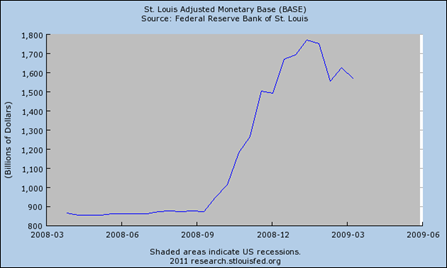
Central banks have flooded financial markets with liquidity since 2008.


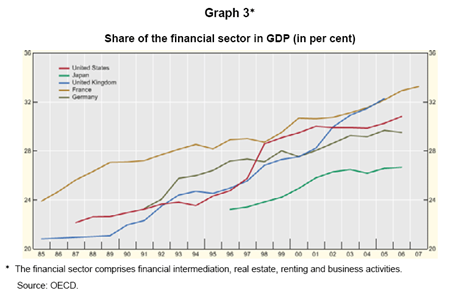
But not all central banks and banks implemented QE policies immediately. UK and US led QE activities because their economies were heavily dependent on financial system.

The initiate intention is to stabilize financial markets and provide liquidity so banks will not fail. But I thought the priority was to support aggregate demand.

This causes some divergence between monetary policy and fiscal policy. In the United States, they deployed aggressive monetary policy action to support sustainable growth and to minimize financial market instability. The divergence arises from various government’s claim to reform tax for corporates, infrastructure spending and investment plans. This causes a disjoint between monetary and fiscal policy.

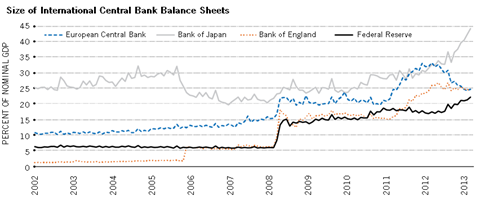
This leads to credit market explosion. In US, Fed’s balance sheet is now close to 25% of GDP. The case of Japan is even more unimaginable. Credit markets have doubled over the past 10 years. This is a rational response to liquidity and low rates.

The chart above shows that the structure of bond markets has changed. Bonds are now increasingly held by mutual funds and other types of funds. This means less market making. This also means most funds have now acclimatized to high liquidity situations.

The key concern is the impact on these investors when rates eventually increase?

Will they systematically face more volatility? Will there be sufficient liquidity to unwind? Aggressive monetary policies can create asset bubbles. This is especially so in equity and credit markets.

Based on basic Keynesian models, the governments of the world should support policies that increase aggregate demand. An example is investing in infrastructure projects that will increase spending. I am worried if the only plan is to continue increasing liquidity.

Thursday, November 10, 2016

Today, I closed down my online tailoring site at www.goodshirtseveryday.com.


About 6 years ago, I had the idea that we could simplify the process of tailoring from measurements to designing. I found the best tailor in Malaysia and put together a website for this purpose. Users could see the design their shirt and see a prototype on screen. They could measure themselves. I provided a guide.

Growth was always weak. The site was built on PHP and JQuery. Making changes on the site was difficult. I understand code, but I am not a professional developer. After paying for development and all expenses, it became tougher to break even.

It was tough to trade off margins for growth. These were some practical challenges and I intend for this post to record some of these.

First, it was difficult to keep track of the fabric that was still in stock. The tailor would run out of fabric from time to time and I had to switch fabric pictures. It created a lot of pain for customers each time I email them to inform them ofstock outs.

Second, after considering logistics costs, the margins were too thin. We often underestimate cross border (Singapore-Malaysia) logistics costs. Customers don’t always see this.

Third, I was bad at marketing our services. I paid Facebook dollars, ran twitter and all major social media accounts. I spoke to friends. The highest conversation was word of mouth.

I had emotional moments when I was frustrated with coding issues and software problems. I reminded myself that I was a minimalist. I turned this pipe of problems off today. It was always painful to kill a project. Dealing with sunk cost mentality was painful. 

Today, I channel the time and effort saved on this project to getting better rest and to other ideas.

Friday, October 28, 2016

Productivity tips: Keep a notebook for all ideas and delegate extensively


Time is a crucial asset that you cannot regain once you’ve lost it

Say “no” to requests that don’t move you forward. Steve Jobs himself declared “Focusing is about saying no.” So don’t be afraid to be ruthless when it comes to tasks that aren’t relevant to your goals.

Nobody can be the best at absolutely everything. We all have strengths and weaknesses, so put your time into the things that you’re good at. The Pareto principle tells us that 80 percent of our results stem from only 20 percent of our actions. So, find that 20 percent that you’re brilliant at, and give it all your attention!

Delegate what can be delegated and work on the rest in a planned manner

Delegation begins with a few questions that require an honest response. How valuable is your task? Are you the only one that could do it well? If not, how could you make the process faster? If you have a task on your hands that isn’t urgent or is something you can’t do so well, it’s time to delegate.

The first of these may come as a surprise: stop using to-do lists. Think about it – half the items tend to stay incomplete, which leaves you with a daunting list of errands and nothing more than extra stress.
Meetings should be reduced to those that are absolutely crucial.

A notebook and a healthy rhythm are two simple but vital tools for your productivity

Paper notebooks are one of the most valuable tools for anyone aspiring to organizational excellence.

A notebook gives you a place to jot down advice, ideas, questions and conversations that come your way. This is a vital process that allows you to make and maintain plans.

Another strategy to keep your energy levels stable is starting the day right. Morning routines that make room for “me-time” can lift your productivity from the outset.

Billionaires often stress the obstacles that meetings pose to focus and workflow, and recommend limiting meetings to a bare minimum. The athletes, on the other hand, emphasize the importance of scheduling.

Rigid routine, particularly in the morning, is a popular strategy to combat an overloaded schedule. Many entrepreneurs considered multitasking as something to avoid, as it simply isn’t effective.

Monday, October 24, 2016

Stop getting cheated - Trading Courses


Trading is active work. It requires you to inspect the stock based on technical or fundamental analysis. Investing should be passive in nature, allow the stock to work when you are resting.

I understand it is tough to read through thousand words essays for trading nuggets. Here are some that I thought you might be interested to read.

Don’t act on impulse. Act based on a system.

From a period of dullness and inactivity, watch for and prepare to follow a move in the direction in which volume increases.

Primary Rule: Limit losses and ride profits, irrespective of all other rules.

Minimize the size of your position when market position is not certain.

Seldom take a position in the direction of an immediately preceding three-day move. Wait for a one-day reversal. This is known as swing trading.

When you take a position, feel free to use price orders. In closing a position, use market orders.

A move followed by a sideways range often precedes another move of almost equal extent in the same direction as the original move. Generally, when the second move from the sideways range has run its course, a counter move approaching the sideways range may be expected.

Watch for volume climax, especially after a long move. After volume spike, it’s time to go.

Enter a position when it breaks out of a base with significant volume.

Exit the position after the stock loses the initial volume for more than 10 days, or exit the next day after a long bearish bar with good volume.

In this channel, I aim to share trading tips for free. There are just too many fraudulent courses that charge thousands of dollars for simple public knowledge that can be attained by just reading books. I’m giving the public a free option, hoping that they can stop paying for useless materials, data, platforms and courses.

I would also like to urge the public to invest in passive funds.

We frequently see reports of how actively managed funds continue to underperform their market benchmarks. In fact, Financial Times have published many articles showing this. 9 out of 10 active funds under perform benchmark. In another report, FT shares 86% of active equity funds under perform.

This is an important conclusion. If we know that most actively managed funds do not beat the market, you should invest in the market cheaply. After all, passively managed funds have the lowest costs and now, the highest returns over time.

There is a book I would like to introduce to you. John Bogle, the founder of Vanguard wrote a few books and this is one of them that will help your investment mentality. I have some simple fund selection rules that will help you.

Investing is not trading


Trading is active work. It requires you to inspect the stock based on technical or fundamental analysis. Investing should be passive in nature, allow the stock to work when you are resting.

We frequently see reports of how actively managed funds continue to under perform their market benchmarks. In fact, Financial Times have published many articles showing this. 9 out of 10 active funds under perform benchmark. In another report, FT shares 86% of active equity funds under perform.

This is an important conclusion. If we know that most actively managed funds do not beat the market, you should invest in the market cheaply. After all, passively managed funds have the lowest costs and now, the highest returns over time.

There is a book I would like to introduce to you. John Bogle, the founder of Vanguard wrote a few books and this is one of them that will help your investment mentality. I have some simple fund selection rules that will help you.

  • Select lowest cost passive funds. ETFs are usually good choices. But there are risks. So make sure you buy cash based ETFs
  • Broad diversification — the more diversified you are, the better you have managed your risk. I urge you to read some of these well published articles and the short book written by John Bogle.


The next decade in 2020


Data management is the new skill set
Data is the new raw material. Left untreated, data is useless. Today, we can process data using big data technologies like Spark and Hadoop. These are the new skills of 2020. Data can be used to create new industries and disrupt existing ones.

Data and Cloud will take many jobs away
Cloud computer has enabled robots to replace manual labor. Robots can learn from stored experiences. Humans must learn by themselves. Robots do not. Experience can be uploaded.

A study by University of Oxford found that 47 percent of all US jobs are at great risk of being done by robots in the next two decades. Within 2 – 3 years, Uber vehicles will be driverless.

Robots can service more people at lower prices and can work all the time. Humans are expensive to hire, fall sick and sometimes cheap. Savings from implementing robots will likely go to MNCs that make them. Government must step in and redistribution income.

You will live longer
Cancer is the result of mutated DNA, which malfunctions, failing to stop the growth of unhealthy cells. A new blood sample test known as a liquid biopsy lets technicians identify even the smallest pieces of cancer DNA in a blood sample. This makes it possible to discover a tumor that’s 1 percent the size of those an MRI can find.

This means more cases can be detected at stage 1 cancer. Ovarian cancers have a 95-percent cure rate when in stage 1. Present technology tends to detect such cancers at stage 3 or 4, when chances of curing the patient are just 5 percent.

Mobile penetration has increased by so much. For example, Kenya’s mobile penetration rate during the first quarter of the 2015-16 financial year has hit 88%, with 37.8million subscribers making use of mobile services. In Indonesia it is estimated that the smart phone penetration rate will reach about 43,2% by 2017, whereas in Sub-Saharan Africa the penetration rate reached 44% in 2015, with 386million unique subscribers and SIM connections. It is estimated that the rate will reach about 49% by 2020. In Latin America, examples of poor or small countries such as Haiti, Venezuela and Honduras, have coverage levels of 75% or less. Cuba has no mobile broadband coverage at all.

Across the developing world, the number of people who are able to access the internet through mobile phones reached 2.5 billion in 2015, which is a significant growth compared to 870 million users in 2010. The mobile internet penetration has reached 40% of the population over developing countries, showing threefold increase for the period of 2010-2015. It is expected that until 2020, an additional number of 1.3 billion people in the developing world will be able to access mobile internet, augmenting the total number of users to 3.8 billion users, accounting for just fewer than 60% of the population.

Because most people have mobile connection, it is now possible to offer medical care over mobile phones in areas where the ratios of doctor to population are less than 1%.

Your financial world will change
Payments will also increasingly be disrupted by technology. Today, most retail payments still route through card associations. There is no way banks and merchants will continue to tolerate scheme fees when other technologies allow direct to wallet payments. In short, the role of schemes and in some cases, even banks, may be diminished. There is a lot of literature on this, so we won’t elaborate on this point.

Top 5 areas that will change in the next decade
The world will change rapidly. Below, I list down 5 areas which I think will transform global population in the next 5 to 10 years.

1. Machine learning
Your phone will start predicting what you want to say. You can relive chatting with your dead relatives or loved ones. Al Bots can record how your loved ones reply and and start emulating them. Machines will be able themselves as humans.

  • Bypass banking and payments verification process
  • Weaken network defense
  • Impose as a social media identity
  • Smarter devices that can interact like a human being

2. Augmented reality
There will be huge implications on learning. Kids can use AR to experience the world. AR is now expensive and inaccessible- battery life, cost of machine and data. In the near future, when sense of smell can be replicated, AR will replace a % of travel.

3. Gene-editing 
You will be able to pay and upgrade your genes. Want to have enhanced performance? Want to reduce cancer rates? Pay a few million dollars, wait in queue and have your genes mapped and edited.

4. Wireless power
Pods will beam enough power to devices. There will be minimum downtime. Battery wastes and charging pains will be a thing of the past. Imagine never having to charge your phone.

How to get ready for change?
Your past experiences will be less important compared to your ability to learn rapidly. Nimbleness will become a core survival tactic for the individual and a firm.